
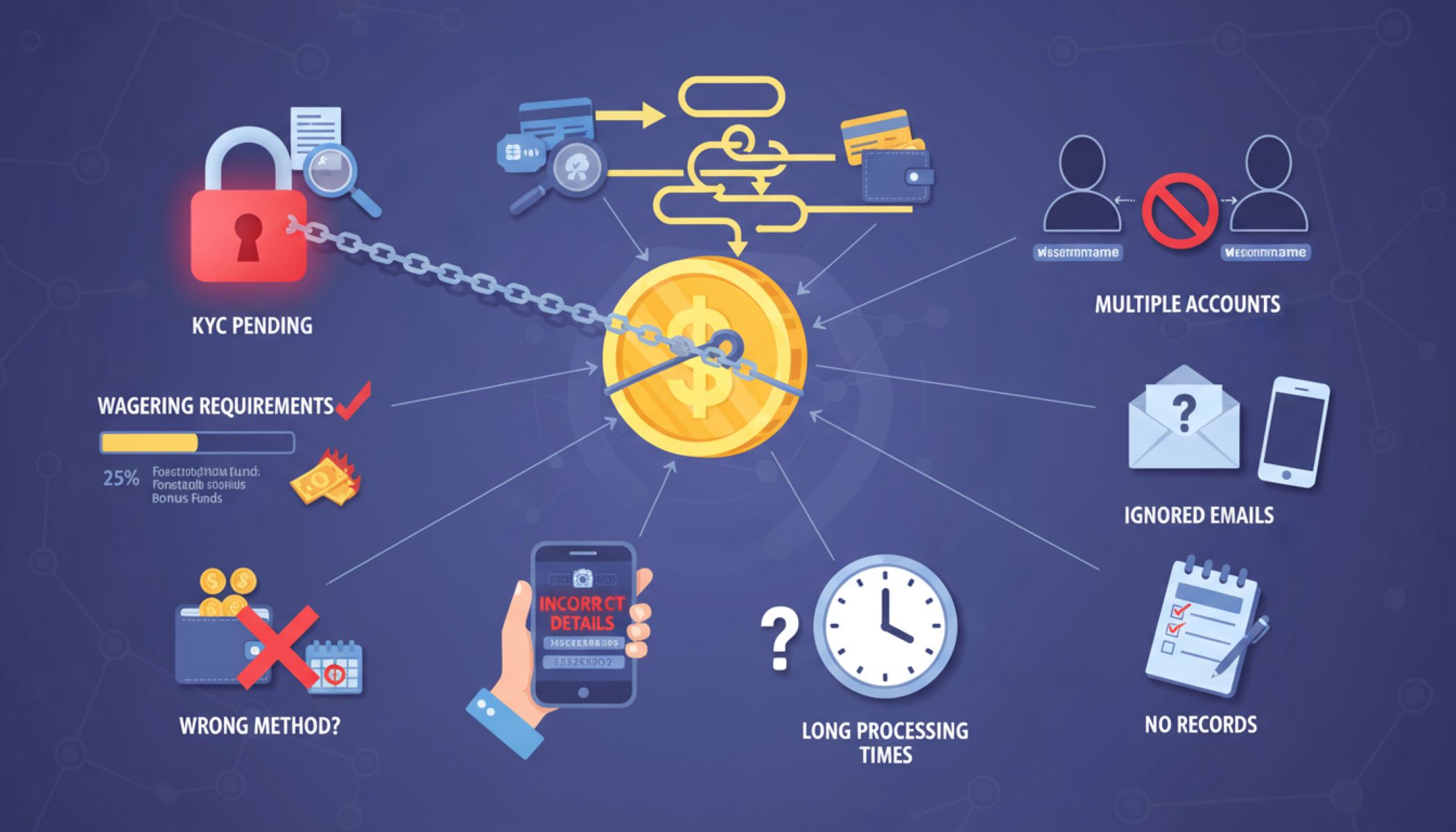
Common withdrawal mistakes players make
Fast and secure withdrawals are the cornerstone of a positive gambling experience in South Africa. When players win, they expect to access their funds quickly and without unnecessary complications. However, the reality is that many South African players encounter significant obstacles when trying to withdraw their winnings, leading to frustrating delays, blocked payouts, and in some cases, complete loss of funds.
The most common withdrawal mistakes include incomplete account verification, unmet bonus requirements, incorrect banking details, choosing inappropriate withdrawal methods, and ignoring active promotion restrictions. These seemingly minor oversights can result in weeks of delays, frozen accounts, and additional documentation requests that could have been easily avoided with proper preparation and understanding of the withdrawal process.
Incomplete or Incorrect Account Verification (FICA)
South African law mandates strict FICA (Financial Intelligence Centre Act) and KYC (Know Your Customer) protocols for all gambling withdrawals. These regulations are designed to prevent money laundering and ensure player protection, but they also create potential pitfalls for unprepared players. The verification process requires specific documentation standards that many players fail to meet on their first attempt.
The most common FICA-related mistakes include uploading expired identity documents, submitting blurry or unclear photographs of documents, providing mismatched information between different documents, and failing to include all required supporting documentation. These errors result in pending or rejected withdrawal requests, forcing players to restart the entire verification process and causing significant delays in accessing their winnings.
- Gather all required documents before starting the withdrawal process, ensuring they are current and clearly legible
- Verify that your name appears identically across all documents and matches your betting account profile exactly
- Take high-quality photographs or scans of documents in good lighting, ensuring all corners and details are visible
- Check that your proof of address is recent (typically within 90 days) and clearly shows your full name and current address
- Submit documents in the correct file format specified by the operator, usually PDF or high-resolution JPEG
- Keep digital copies of all submitted documents for future reference and potential resubmission requests
How to Fix Common FICA Mistakes
When verification errors occur, immediate action can minimize delays and get your withdrawal back on track. The key is to identify the specific issue and address it systematically rather than repeatedly submitting the same incorrect documentation.
Start by contacting customer support to understand exactly which documents were rejected and why. Update any expired documents immediately, ensuring replacement documents show consistent information. Pay particular attention to address consistency across all documents, as mismatched addresses are a leading cause of verification delays.
Consider pre-validating your identification documents with customer support before initiating large withdrawals, especially if you’ve recently moved or changed banks. This proactive approach can identify potential issues before they impact your withdrawal timeline.
- Replace any expired documents with current versions before submitting withdrawal requests
- Ensure address consistency across all documents, updating banking details if you’ve recently relocated
- Use document scanning apps to improve image quality rather than standard phone cameras
- Contact customer support for document pre-validation before initiating large withdrawal requests
- Maintain a digital filing system of approved documents for future withdrawal needs
The Impact of Incomplete Verification
Incomplete or incorrect verification can extend withdrawal delays from the standard 24-48 hours to several weeks or even months. During this period, accounts may be temporarily frozen, preventing both deposits and withdrawals until verification is complete.
In severe cases where documentation cannot be adequately verified, operators may void winnings entirely, particularly if they suspect fraudulent activity or cannot confirm the account holder’s identity. This underscores the critical importance of maintaining accurate, up-to-date verification documentation at all times.
Unmet Wagering or Bonus Requirements
Bonus wagering requirements represent one of the most misunderstood aspects of online gambling, leading to countless withdrawal rejections. Many players fail to read or fully comprehend the play-through terms attached to bonuses, welcome offers, and promotional deposits. These requirements typically mandate that bonus funds be wagered a specific number of times before becoming withdrawable.
Common errors include attempting to withdraw promotional money before meeting wagering requirements, miscalculating the remaining play-through amount, or failing to understand which games contribute toward requirement fulfillment. Players often assume that any funds in their account are immediately withdrawable, not realizing that bonus conditions may still be active.
The consequences of premature withdrawal attempts can be severe, ranging from simple request rejection to complete forfeiture of bonus funds and associated winnings. Some operators maintain strict policies where any withdrawal attempt before requirement completion voids the entire bonus package.
Understanding the specific terms of each bonus type is essential for successful withdrawals. Different promotions carry varying wagering requirements, time limits, and game restrictions that directly impact withdrawal eligibility.
| Bonus Type | Wagering Requirement | Typical Error | Consequence | Recommended Action |
|---|---|---|---|---|
| Welcome Bonus | 35x bonus amount | Withdrawing before completion | Bonus and winnings voided | Check wagering progress before withdrawal |
| Free Spins | 40x winnings | Playing restricted games | Progress reset to zero | Read eligible games list carefully |
| Reload Bonus | 25x bonus amount | Mixing bonus and real money | Confusion over withdrawable funds | Track bonus balance separately |
| No Deposit Bonus | 50x bonus amount | Exceeding maximum bet limits | Winnings capped or voided | Maintain conservative bet sizing |
| Cashback Offer | 10x cashback amount | Assuming no wagering required | Withdrawal request rejected | Verify terms before claiming |
Avoiding Wagering Errors
Prevention is always better than cure when it comes to wagering requirement mistakes. Always check your bonus status and play-through progress before initiating any withdrawal request. Most reputable operators provide real-time tracking tools that show exactly how much wagering remains and which games contribute toward requirement completion.
Develop a habit of reading bonus terms completely before accepting any promotional offer. Pay particular attention to time limits, as uncompleted wagering requirements typically expire, resulting in loss of bonus funds and associated winnings. Some bonuses have maximum withdrawal caps that limit how much you can cash out even after meeting all requirements.
Consider declining bonuses if you prefer the flexibility of unrestricted withdrawals. While bonuses can provide additional playing value, they come with strings attached that may not align with your playing style or withdrawal preferences.
Incorrect or Outdated Banking Details
Banking detail errors represent a significant source of withdrawal delays and lost funds for South African players. Simple mistakes like mistyping account numbers, providing mismatched bank account names, or attempting to use expired payment cards can result in returned funds or processing delays that extend for several days.
These errors are particularly common with bank transfer and card withdrawals, where precise information is essential for successful processing. Even minor discrepancies between the name on your betting account and your bank account can trigger security reviews and additional verification requirements.
- Account holder name must match exactly between betting profile and bank account details
- Account numbers should be double-checked digit by digit before submission to prevent costly errors
- Expired or cancelled payment cards will cause automatic withdrawal rejections and processing delays
- Closed bank accounts can result in permanently lost funds if not updated promptly
- International banking details may trigger additional compliance checks and extended processing times
How to Check and Update Bank Details
Always double-check your banking information input, paying special attention to account numbers and routing codes. Ensure that the account holder name matches your betting profile exactly, including any middle names or initials that appear on official documents.
When changing banks or updating payment methods, consult customer support before initiating withdrawals to confirm that new details have been properly verified and activated. Some operators require additional verification when banking details are changed, particularly if the new account is with a different financial institution.
Specific Pitfalls with Mobile/E-wallet Withdrawals
Electronic wallets and mobile payment solutions require exact detail matching and active account status for successful withdrawals. Unlike traditional banking, these platforms often have stricter verification requirements and may reject transactions for seemingly minor discrepancies.
Common issues include dormant e-wallet accounts, exceeded transaction limits, and mismatched personal information between gambling and e-wallet accounts. Always verify that your e-wallet account is active and in good standing before requesting withdrawals.
- E-wallet accounts must be active and verified to receive gambling withdrawals successfully
- Mobile money accounts require exact phone number matching and sufficient account limits
- Some e-wallets have daily or monthly limits that can prevent large withdrawal processing
- Currency mismatches between gambling account and e-wallet can cause conversion delays or rejections
Choosing the Wrong Withdrawal Method
Selecting an inappropriate withdrawal method can significantly extend processing times, increase fees, or trigger additional security checks. Some payment methods are inherently slower, have higher associated costs, or may not align with your deposit method, potentially causing anti-money laundering reviews.
Understanding the strengths and limitations of each withdrawal option helps players make informed decisions that minimize delays and maximize convenience. Wrong method selection often compounds other withdrawal mistakes, creating cascading delays that could have been avoided with better initial planning.
The key is matching your withdrawal method to your specific needs, considering factors like processing speed, fees, limits, and compatibility with your deposit method. Some operators require withdrawal methods to match deposit methods for security purposes, making method selection even more critical.
| Withdrawal Method | Processing Time | Common Issues | Max/Min Limits | When to Use |
|---|---|---|---|---|
| Bank Transfer | 1-3 business days | Incorrect account details | R100 – R50,000 | Large withdrawals |
| Credit Card | 3-5 business days | Expired cards, chargebacks | R50 – R10,000 | Matching deposit method |
| E-wallet | 2-24 hours | Account verification | R20 – R25,000 | Fast access needed |
| Cryptocurrency | 15 minutes – 2 hours | Wallet address errors | R100 – R100,000 | Maximum privacy |
| Mobile Money | 1-4 hours | Network limitations | R10 – R5,000 | Small, frequent withdrawals |
Best Practices for Multi-method Withdrawals
Whenever possible, match your withdrawal method to your deposit method to minimize security reviews and processing delays. This approach reduces the likelihood of anti-money laundering flags and demonstrates consistent financial behavior to operators.
Always check withdrawal limits and method eligibility before initiating requests, particularly for large amounts that may exceed daily or monthly thresholds. Some methods may not be available for withdrawals even if they were used for deposits, so verify options in advance to avoid disappointment.
Ignoring Pending Bonus/Promotion Restrictions
Active promotions and bonuses often carry withdrawal restrictions that many players overlook until they attempt to cash out. Trying to withdraw funds while an active promotion is running typically results in automatic request blocking, even if the restriction isn’t immediately obvious from the account balance display.
Always double-check your casino or sportsbook promotional status before requesting payouts, as even seemingly inactive bonuses may still impose withdrawal restrictions. Some promotions have extended terms that remain in effect long after the initial bonus period expires.
| Situation | Pro | Con |
|---|---|---|
| Active Welcome Bonus | Extra funds for extended play | Complete withdrawal restriction until wagering complete |
| Loyalty Program Credits | Accumulated rewards and benefits | May require minimum activity before withdrawal |
| Tournament Entry | Potential for additional prizes | Funds locked until tournament completion |
Resolving Active Bonus Conflicts
When facing active bonus restrictions, you typically have several options to restore withdrawal eligibility. The most straightforward approach is completing the bonus requirements, but this may not always be practical or desirable.
Many operators allow bonus forfeiture, enabling immediate withdrawal access at the cost of losing bonus funds and associated winnings. Contact customer support to understand your specific options and their consequences before making decisions.
- Review your account promotions section to identify all active bonuses and their specific terms
- Calculate remaining wagering requirements and assess whether completion is feasible within the time limit
- Contact customer support to discuss bonus forfeiture options if immediate withdrawal is needed
- Document any bonus cancellation requests through official channels for future reference
- Verify withdrawal eligibility before initiating requests to avoid processing delays
Loyalty/VIP Program Withdrawal Mistakes
VIP and loyalty program members often face unique withdrawal challenges that standard players don’t encounter. These programs frequently have tier-specific withdrawal limits, batch processing rules, or minimum activity requirements that can catch even experienced players off guard.
Higher-tier members may have access to enhanced withdrawal limits but could also face additional verification requirements or dedicated processing timelines that differ from standard procedures. Understanding your program’s specific rules prevents unnecessary delays and ensures optimal benefit utilization.
Reversal or Cancellation of Withdrawals
Withdrawal reversals represent one of the most dangerous mistakes players can make, often leading to complete loss of winnings through continued gambling. Many operators facilitate easy reversal options during pending periods, creating temptation for players to cancel legitimate withdrawal requests.
The reversal window varies significantly between operators, with some allowing cancellations up to several days after the initial request. Understanding these timeframes and their associated risks is crucial for maintaining financial discipline and protecting your winnings from impulsive decisions.
Once funds are returned to your gaming account through reversal, they become subject to the same risks as any other gambling bankroll. Studies consistently show that reversed withdrawals are rarely re-withdrawn successfully, as players typically lose the returned funds through continued play.
- Avoid checking your account frequently during withdrawal processing to reduce reversal temptation
- Set up account notifications that confirm withdrawal completion rather than relying on manual checking
- Consider requesting withdrawal limits that prevent reversal capabilities once requests are submitted
- Understand your operator’s specific reversal window and plan accordingly to maintain discipline
- Use responsible gambling tools to lock accounts during withdrawal processing if reversal temptation is strong
- Remember that reversed funds are rarely successfully withdrawn on subsequent attempts
Risks of Withdrawal Reversal
Withdrawal reversal creates significant exposure to problem gambling behaviors and is strongly linked to addictive gambling patterns. The act of reversing a withdrawal often indicates underlying impulse control issues that can escalate quickly without proper intervention.
Players who frequently reverse withdrawals typically develop a cycle where winnings are never actually realized, leading to extended losing streaks and potential financial harm. This pattern is one of the clearest indicators of problematic gambling behavior and should prompt immediate self-reflection and possible professional help.
Fraud Checks, AML Delays, and Suspicion Flags
Anti-money laundering (AML) reviews and fraud prevention measures can trigger unexpected withdrawal delays even for legitimate players. Transactions that appear suspicious due to mismatched data, atypical withdrawal amounts, or unusual activity patterns may prompt additional scrutiny from operator security teams.
These reviews are mandatory under South African gambling regulations and cannot be bypassed, regardless of player frustration or urgency. Understanding what triggers these checks and how to resolve them efficiently can minimize disruption to your withdrawal experience.
Common triggers include first-time large withdrawals, sudden changes in betting patterns, deposits from multiple sources, or any discrepancies in personal information. Players may face temporary payout holds, requests for additional documentation, or even return-to-sender outcomes for funds that cannot be properly verified.
| Reason for Check | Trigger | Typical Outcome | Resolution Steps |
|---|---|---|---|
| Large Amount Review | Withdrawals over R25,000 | 24-72 hour security review | Provide source of funds documentation |
| Pattern Analysis | Unusual betting behavior | Extended verification process | Explain betting strategy and provide game logs |
| Multiple Deposits | Various payment sources | Identity verification required | Verify ownership of all payment methods |
| Geographic Flags | Location inconsistencies | Account temporarily suspended | Provide proof of current location |
| Velocity Monitoring | Rapid deposit-withdrawal cycles | Enhanced due diligence | Demonstrate legitimate gambling activity |
Preventing Fraud Flag Issues
Maintaining consistent withdrawal behavior and avoiding suspicious patterns significantly reduces the likelihood of fraud flag complications. Stay within your normal betting and withdrawal patterns, avoid unnecessarily splitting large amounts into multiple smaller transactions, and never use third-party bank accounts for gambling transactions.
Building a positive history with operators through consistent, transparent behavior creates trust that can expedite future withdrawal processing and reduce the likelihood of detailed security reviews.
- Maintain consistent betting patterns and avoid sudden dramatic changes in wagering amounts
- Use only personal bank accounts and payment methods registered in your own name
- Avoid splitting large withdrawals unnecessarily, as multiple small transactions can appear suspicious
- Keep detailed records of gambling activity to explain unusual patterns if questioned
- Respond promptly and completely to any security team requests for additional information
Chargebacks: The Hidden Danger
Initiating unwarranted chargebacks against gambling deposits represents one of the most serious mistakes players can make, often resulting in immediate account closure, forfeiture of all winnings, and potential regulatory blacklisting. Chargebacks should only be used for genuine unauthorized transactions, never as a dispute resolution mechanism for legitimate gambling losses.
Operators maintain detailed records of all transactions and player activity, making fraudulent chargeback claims easy to identify and defend against. The consequences extend far beyond the immediate account, potentially affecting your ability to gamble with other operators who share security information within the industry.
Neglecting Responsible Gambling Safeguards During Withdrawals
Problem gambling often manifests most clearly during the withdrawal process, with repeated withdrawal reversals, chasing losses, or attempts to hide transactions from family members serving as warning signs of developing addiction. Failure to utilize available safeguards like cooling-off periods, loss limits, or self-exclusion tools can lead to severe financial and personal harm.
The withdrawal phase presents both opportunity and risk for players struggling with gambling control. While successful withdrawals represent profit realization, the temptation to reverse withdrawals and continue playing can be overwhelming for those with impulse control issues.
Recognizing the warning signs and implementing preventive measures before problems escalate is crucial for maintaining healthy gambling habits and protecting personal finances. Modern operators provide numerous tools designed to help players maintain control, but these safeguards are only effective when actively utilized.
- Frequent withdrawal reversals indicate potential impulse control problems requiring immediate attention
- Hiding gambling transactions or withdrawals from family members suggests problematic behavior patterns
- Chasing losses through continued play after initiating withdrawals demonstrates poor bankroll discipline
- Unable to maintain discipline during withdrawal processing periods signals need for additional safeguards
- Experiencing anxiety or stress related to withdrawal decisions may indicate underlying gambling problems
- Rationalization of reversal decisions typically masks impulse control issues that require professional intervention
How to Use Withdrawal-Related Gambling Controls
Most operators provide comprehensive responsible gambling tools that can be activated to prevent withdrawal-related problems before they develop into serious addiction issues. These controls range from temporary cooling-off periods to permanent self-exclusion options.
The key is implementing these safeguards proactively rather than reactively, establishing protective measures during clear-headed moments rather than waiting until problems have already emerged and rational decision-making has become compromised.
- Activate cooling-off periods during emotional or stressful periods to prevent impulsive gambling decisions
- Set withdrawal processing locks that prevent reversal capabilities once requests are submitted
- Implement deposit limits that restrict available funds during withdrawal processing periods
- Establish regular self-assessment schedules to monitor gambling behavior and withdrawal patterns
- Contact operator support to discuss enhanced account restrictions if control becomes difficult to maintain